A Simple Guide to DME HCPCS Codes That You Need to Know
When a patient leaves the hospital after being prescribed a wheelchair, CPAP device or an oxygen concentrator, it has to be billed. And for that particular billing, there must be a specific code. But which one of the three sets of codes is the right one?
The ICD-10 code explains why a patient needs a specific procedure or a service performed. It is the code that defines the nature of the disease or condition.
The CPT code enlists what diagnostic procedure was performed. The HCPCS code provides information on what item was supplied. For the situation said above, as you've guessed already; we'd need the HCPCS codes.
In this guide, we will review HCPCS codes in DME billing and explain all you should know about them.
What Are HCPCS Codes?
HCPCS is an acronym for Healthcare Common Procedure Coding System. HCPCS codes, which are pronounced “hick-picks,” are alphanumeric codes, used to describe medical equipment, supplies, and procedures for reimbursement purposes.
They are used by medical practices for Durable Medical Equipment billing to document the supplies provided and later submitted to Medicare or Medicaid to get paid.
These codes are revised quarterly. This implies that the codes that were valid six months ago are no longer valid. Every code comprises a letter and four numerals e.g., J0173, E0431. Also, it is to note that the letter indicates the type of code.
What Are Different DME HCPCS Codes?
Every starting letter of the HCPCS code tells us the type of equipment supplied. Knowing the starting letter makes looking up the code much easier and faster. For DME billing, you can expect more than 650 to 700 specific active codes that reside mainly in the "E" and "K" sections of the alphabet.
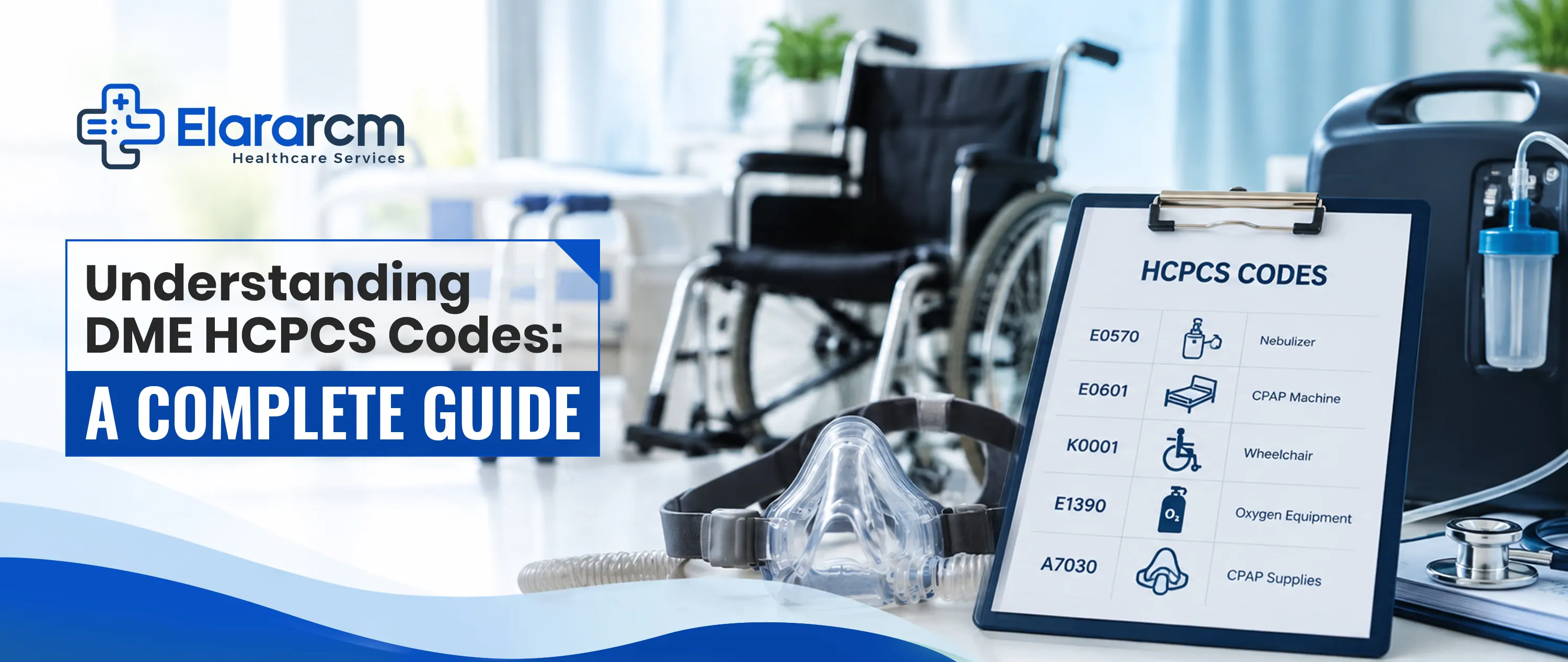
- E Codes (E0100-E8002): Durable medical equipment such as wheelchairs, hospital beds, walkers, CPAP machines, and oxygen equipment. E Codes are most frequently used codes in the DME billing.
- K Codes (K0000-K9999): Temporary codes used for coding equipment that is not categorized permanently, such as power wheelchairs (K0001 for regular manual wheelchair and K0813 for power wheelchairs).
- A Codes (A4000-A9999): Medical supplies and accessories, such as blood glucose test strips (A4253) and catheter supplies.
- L Codes (L0100-L9900): Orthotics and prosthetics (knee braces, ankle braces, etc.).
- Q Codes (Q0035-Q9992): Temporary codes used for items like speech-generating devices and medical supplies.
What Are DME Modifiers and Why Do They Matter?
DME modifiers are two-letter modifiers attached to a HCPCS code. They tell more details about the condition of the equipment that was furnished to the patient, basically the fact that if the equipment was new, rental, or used.
Most useful DME modifiers:
- NU – New equipment
- RR – Equipment that was rented
- UE – used equipment purchased at a reduced price
- KX- Necessary documentation is present and confirms that medical necessity criteria are met
- GA – An Advance Beneficiary Notice is signed by the patient
- GY – The item is excluded from coverage
Not only will a missing modifier or an incorrect modifier result in delayed payments, but it will also lead to denial of the payment, which would mean that the entire claim would have to be revised and resubmitted.
There is also the case of the KX modifier, which should receive special attention due to the fact that it is needed for many DME claims under Medicare.
What Is DME Billing and Why Does It Go Wrong?
DME billing is the process of filing claims to insurance carriers in connection with the durable medical equipment delivered to patients for at-home use.
DME billing is the most denial prone category of all in the field of health care services because it involves such elements as documentation, coding, modifiers and authorization on top of specific payer coverage policies.
The most typical DME billing mistakes include the choice of a non-specific code in case there is a more specific one; omission of modifiers, filing claims without a detailed written order from the physician; and inappropriate codes of either rental or purchasing of the equipment in question.
Each of the listed mistakes is preventable through proper process before the filing.
How To Avoid the Most Common DME HCPCS Billing Mistakes:
DME billing is dependent on doing the proper checks at the proper times, before the billing itself can take place.
Ensure that the Detailed Written Order is complete before the billing
In all DME claims, there should be the DWO signed by the ordering physician. Furthermore, it should contain the patient's name, the DME ordered, diagnosis, and physician's signature. Lack of DWO leads to denial of the claim automatically in most Medicare and commercial claims.
Match the ICD-10 diagnosis code to the equipment billed
The ICD-10 diagnosis should support the necessity of DME claimed. Basing the claim of CPAP machine on the ICD-10 code for hypertension without any sleep disorders diagnosis would lead to denial of medical necessity review.
Choose the most specific HCPCS code
Make sure you don’t choose the general E1399 (miscellaneous DME) for any equipment that you have a specific E code for. It is a common mistake that results in a denial, so use the correct and specific code, always!
Choose the right modifier to indicate supply type and documentation
If you deliver rental or sell equipment, make sure of it before applying any modifiers. Make sure you have proper documentation to apply KX modifier. Ensure the ABN was signed before applying GA.
Verify prior authorization before delivering equipment
Some payers need prior authorization for power wheelchairs, oxygen, and hospital beds. Otherwise, delivering it will result in a hard denial.
Elara Healthcare Services specializes in DME billing services which include coding according to HCPCS codes, documentation accuracy, review of modifiers, denial management, and prior authorizations.
In case your DME denials are more than they ought to be, contact us and let us help you fix your revenue cycle