A Guide on Accurate Charge Capture Stops Revenue from Disappearing
One of the most common misconceptions about the origin of revenue issues is that these problems originate in the claims. Incorrect coding, modifier, lack of authorization, and the denial follows, and the billing process starts working.
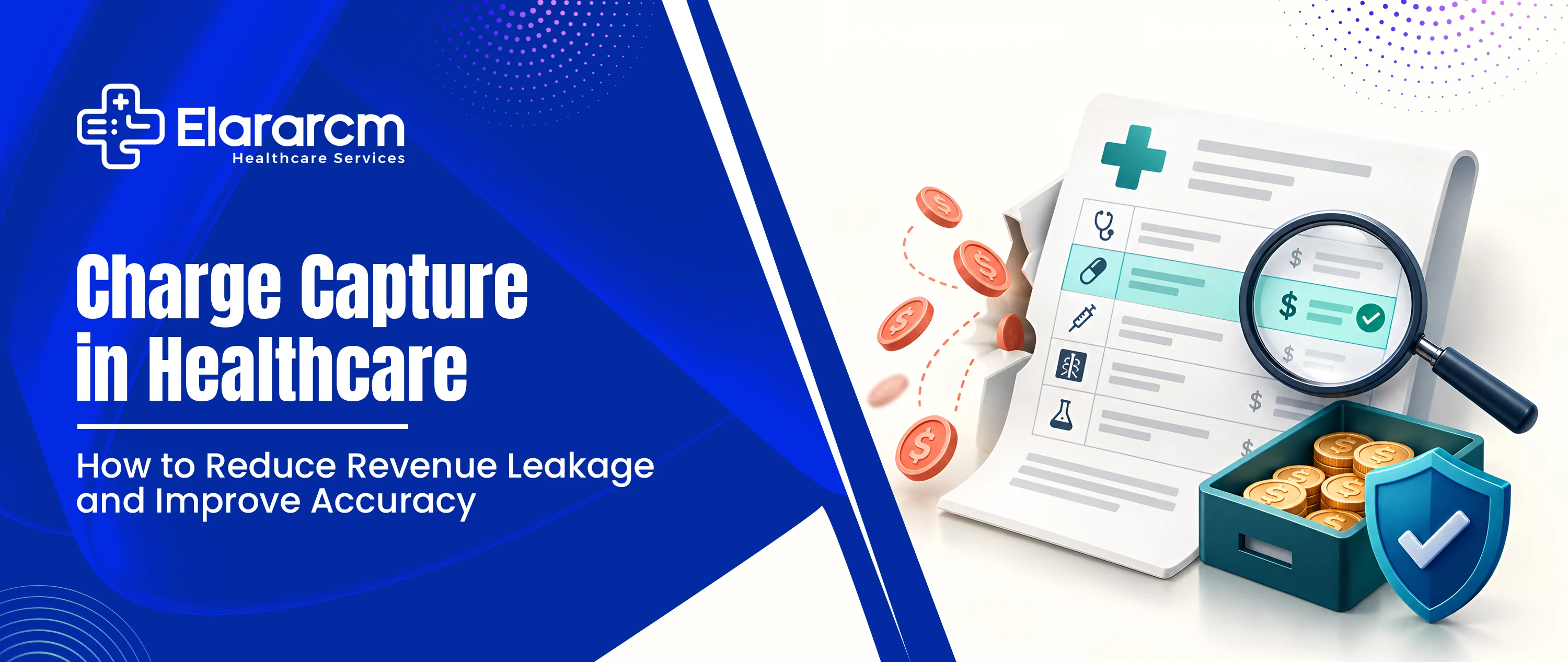
However, not all revenue loss in the healthcare industry ever reaches the claims because the revenue was not even documented properly. Revenue integrity-based medical billing services recognize this difference.
In 2025, denials and uncompensated care amounted to $48 billion in revenue loss for 2,300 US hospitals, which was 25% more than last year. Up to 1% of net charges can be lost due to failure to capture charges each year by the healthcare system.
This number itself does not seem to be a big problem. At $4 billion in annual net operating revenue, this means losing $40 million even before billing.
What Is Charge Capture in Healthcare?
Charge capture is the practice of recording and documenting every service, procedure, item or drug administered to a patient and turning that clinical event into a billable charge. Basically, it’s the link between what occurs in the examination room and what gets posted on the claim.
If charge capture is done effectively, everything is captured, coded properly and sent for billing before the deadline set by the payer. If there is a bottleneck though, due to lack of documentation, coding error or failure to capture at all in the workflow, revenue just goes away without generating any denial; no notification, no bounce back, nothing.
How Does Poor Charge Capture Affect the Whole Revenue Cycle?
Poor charge capture impacts every process in the chain because these processes depend on information about what care has been provided and how many patients have visited the facility, which is not always accurate due to missing charges.
If charges are overlooked or delayed, the cash flow becomes difficult to forecast because calculations of the revenue amount are based on inaccurate figures. Financial managers allocate the budget for work with limited information. And finally, the billing department stops optimizing the process and starts reconstructing the cases instead.
How To Improve Charge Capture Accuracy in a Healthcare Practice
Charge capture optimization entails reducing the distance between where services are rendered and where charges are captured through structuring and not merely reminders.
Step 1: Document every possible charge entry point
The process should include identifying where charges are created, who does it, and what is the transfer point between the clinical documentation and the billing process. Most organizations find that the disconnect between the services and charges happens at the transfer point; documented charges that have never been captured.
Step 2: Enable real-time charge entry
Charge entries made the same day on which services are provided are more likely to be accurate and complete than charge entries done from clinical documents the next day. Mobile charge capture solutions will enable providers to create their charge entries at the point of care and eliminate any errors or delays.
Step 3: Incorporate an automated charge reconciliation process
Systems that check the difference between scheduled procedures and the submitted charges can identify any inconsistencies prior to claim submission. An integrated health organization improved charge capture accuracy through automated charge reconciliation, resulting in a $7.8 million increase in revenue annually.
Step 4: Monthly audit of charge categories with high risk for under-capture
Secondary billing processes, implantables, expensive medications, and complicated cases of multiple services are the areas that experience failures in charge capturing. Regular monthly audit of these categories by comparison of services provided, and charges will reveal these patterns prior to their institutionalization.
Step 5: Development of the feedback loop between billing and clinical departments
Even if a billing department employee discovers a missed charge, it is impossible to do anything about the matter without involving clinicians. The feedback loop mechanism will make the providers realize which charges were overlooked and why in a way different from training alone.
What Role Does Technology Play in Reducing Charge Capture Failures?
Technology increases the precision of charge capture by using automation of the reconciliation process which cannot be achieved manually; it points out any missing charges, finds underbilling trends, and reduces the time of manual verification that hampers every following stage.
According to KLAS research, advanced charge capture systems allow organizations to automate their billing audits, to find missing charges, and reduce the amount of time for manual review. Omega Healthcare automated its revenue cycle processes for more than 350 organizations and saved about 15,000 employee hours per month while maintaining 99.5% accuracy of processing.
Technology scales up what cannot be done manually. Yet, technology cannot create any charges for non-existing services. The documentation process itself must take place. What automation does is providing the structure that guarantees everything that was documented to be properly billed.
Elara Healthcare Services provides charge capture support and revenue integrity services designed to close the gap between clinical documentation and billing accuracy.